
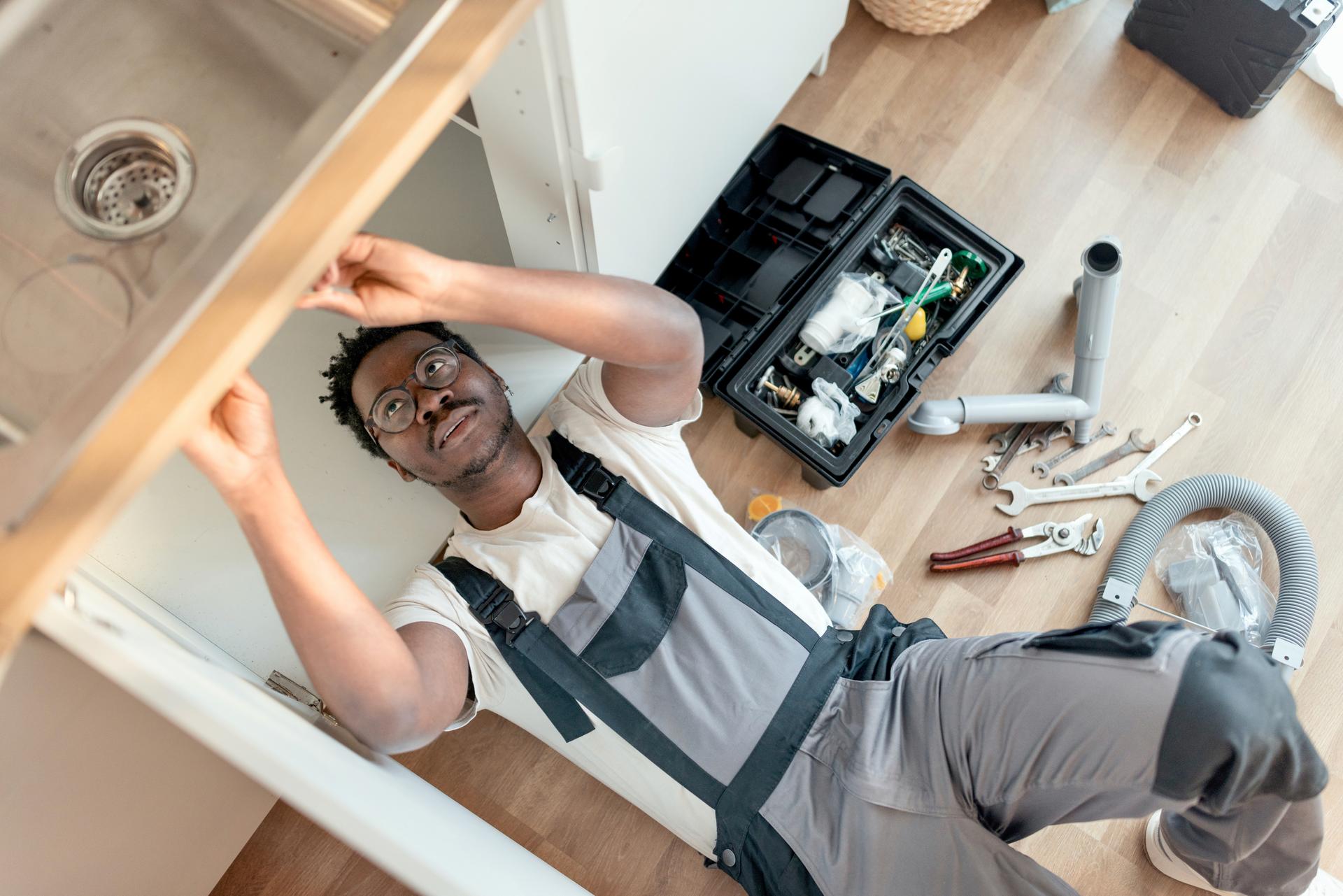
Becoming a plumber can be a rewarding career with plenty of room for growth, especially in fast-growing states like Florida. However, you are required to have a plumbing license to work in Florida, and the licensing process can be complicated.
The entire process takes a minimum of four years, but the time commitment is worth it. The Bureau of Labor Statistics reports a 6% job growth over the next decade for plumbers, pipefitters, and steamfitters, and Florida has the third highest demand for plumbers – behind California and Texas.
In Florida, you will find certified plumbers who can work anywhere in the state, and registered plumbers who are restricted to working in the local municipality where registered. The steps to becoming certified or registered are essentially the same and include a combination of work experience and education before taking and passing an exam.
What Does a Plumber Do?
Plumbers do a lot more than connect pipes—they install, maintain, repair, and design plumbing systems in residential and commercial spaces. Plumbers can perform any of these functions for sewer or storm drainage facilities, private water systems, septic tanks, swimming pool piping, irrigation, solar heating systems, gas line piping, and pneumatic control piping systems.
Successful plumbers are expert problem-solvers with advanced troubleshooting skills, know how to read and interpret construction drawings and blueprints, and have technical and mechanical know-how to correctly install, fit, and connect piping to avoid leaks and maintain adequate flow.
Plumbers work in residential and commercial settings. Within those settings, some plumbers choose to specialize in service or construction plumbing.
What’s the difference between a registered vs. certified plumber in Florida?
There are two types of licensed plumbers in Florida:
- Certified Plumbers
- Registered Plumbers
A certified plumber can work statewide. Their license is issued by the Department of Business and Professional Regulation (DBPR). To become certified, you must meet the education and experience requirements and pass a written test. Certified plumbing contractors must meet a background check, have adequate insurance, and pay licensing fees. Their occupation code is designated with the letter “C.”
A registered plumbing contractor is restricted to working within the jurisdiction where the registration was issued. They are required to meet education and experience requirements and pass a test showing competency in the profession and local regulations where they intend to work. Registered plumbers are designated by the letter “R” on their license.
These two designations apply to your license whether you’re a journeyman level or master level plumber. The same designation applies to those who get their plumbing contractor’s license.
Residential Plumbers
Residential plumbers work on plumbing systems in single- and multifamily housing. The work entails installing, maintaining, and repairing water, drain, and sewer lines and installing and troubleshooting appliances such as dishwashers, toilets, bathtubs, and water heaters.
Commercial Plumbers
The scope of work for commercial plumbers is like that of residential plumbers, but on a much larger scale. They work with a complex network of water supply and drainage systems in commercial buildings, large multifamily dwellings, schools, retail outlets, and other public spaces. Commercial plumbing systems handle much larger volumes of flow, have more fixtures, and complex layouts.
Service Plumbers
Service plumbers are expert troubleshooters who spend most of their day making repairs to existing plumbing systems. These plumbers navigate the challenges of retrofitting older and outdated systems with new materials when replacing or repairing broken pipes and fixtures. Service plumbers also install new systems when the old one can no longer be patched.
New Construction Plumbers
Plumbers who specialize in new construction work with a blank slate. They are experts at reading and interpreting blueprints. They understand the construction process and where their role as plumbers fits into the overall project. New construction plumbers are excellent communicators and well-versed in all aspects of residential or commercial plumbing, depending on their setting of interest.
Basic Requirements to Becoming a Licensed Plumber in Florida
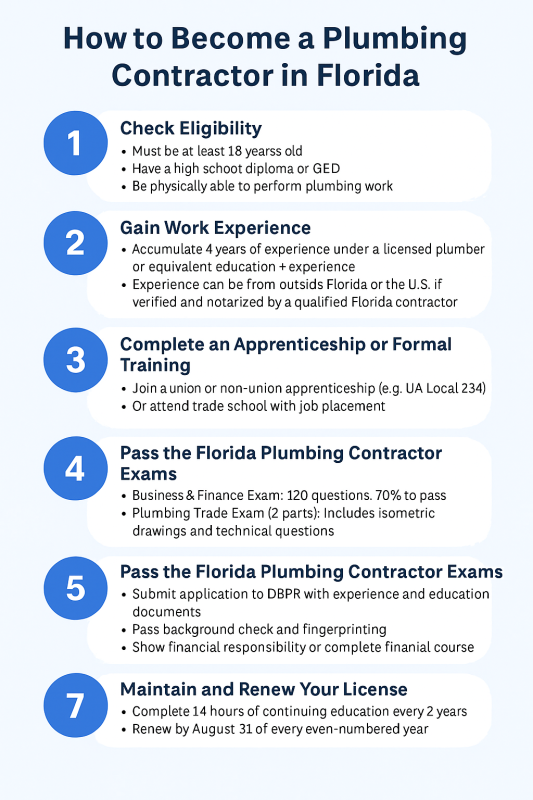
Whether you’re going for a “C” or “R” on your plumbing license, the steps to becoming licensed in Florida are essentially the same. You must be physically fit enough to do the job, able to squeeze into tight spaces, and work in hot and humid conditions.
You must also meet some basic requirements:
- Be at least 18 years old with a high school diploma or GED.
- Complete the required experience and education.
- Verify on-the-job experience.
- Pass an exam.
- Acquire liability insurance.
- Demonstrate financial responsibility.
- Complete a criminal background check.
Obtain the Required Education and Training
Before you can get your license as a journeyman plumber, you need to prove you meet the education and experience requirements. While you’re not required to attend a vocational training program or community college, you are required to get a minimum of four years of documented experience before you can take the exam. However, education counts toward experience.
Here is a look at the different methods you can use to qualify to sit for your journeyman plumbing license exam:
- A four-year construction related degree from an accredited college and one year of proven experience.
- Three years of credits from accredited college-level courses and one year of experience as a plumbing foreman.
- Two years of credits from accredited college-level courses, one year of experience as a plumbing foreman, and one year as a worker.
- One year of credits from accredited college-level courses, one year of experience as a plumbing foreman, and two years as a worker.
- Four years of documented experience with one of those years as a plumbing foreman.
Journeyman plumbers work under the supervision of a master plumber. To obtain your master plumbing license, you need an additional two years of experience as a journeyman plumber and pass an exam.
Master plumbers work independently. However, if you wish to hire employees, you will need your Florida plumbing contractor’s license.
To open a business where you intend to hire employees, you will apply for the Certified Plumbing Contractor Qualifying Business license. The requirements are the same for getting your journeyman license with the exception of carrying workers’ compensation insurance.
How to Find an Apprenticeship Program
Apprenticeships combine work experience and classroom instruction. One of the benefits of joining an apprenticeship program is that you begin to make money right away without the costs of paying for an education.
A plumbing apprenticeship program is offered through the UA Local 234 union in Jacksonville, Florida. To participate, you will be required to join the union.
Gain On-the-Job Experience
On-the-job experience is required to get your license. Most trade schools will offer job placement services. The benefits of beginning to work in the field include learning about the day-to-day work as a plumber and gaining valuable experience that will help you pass the written portion of your exam.
Apprenticeship programs are an excellent way to start working right away. Another option is finding a master plumber or plumbing contractor willing to hire someone new to the industry. Keep in mind, apprenticeship programs often include an educational component. That doesn’t mean you can’t get your license without classroom hours; it just means that you will need four years or 8,000 hours of experience.
The number of working hours you need to sit for your journeyman license depends on how many classroom credits you earn.
Pass the Florida Plumbing Licensing Exams
The two-part exam includes the Plumbing General Trade Knowledge test and the Business and Financial Management test. You’re required to pass both parts with a 70% or better. The Business and Financial Management exam has 120 questions and is completed at a testing center.
The Plumbing General Trade Knowledge portion is a written test. The trade exam is divided into a morning session consisting of 45 equally weighted questions and five isometric drawings worth 10 points each and an afternoon session with 65 equally weighted questions. Both sessions have a four and a half hour time limit to complete.
The exam tests your knowledge in:
- Drainage (20%)
- Water distribution (20%)
- Natural gas piping (15%)
- Medical gas piping (20%)
- Industrial piping (10%)
- Swimming pools, wells, and irrigation (5%)
- Solar (5%)
- Fire protection (5%)
The trade exam covers reading and interpreting plans and specifications, interpreting codes, basic math, plumbing components and installation techniques, maintenance techniques, OSHA regulations, tools and equipment, and isometric drawing and interpretation.
Only designated reference materials listed on the DBPR website are allowed. This includes bound pdf reference material or bound books. Referenced books can be permanently tabbed and highlighted; however, no removal tabs (Post-it™ notes) or handwritten notes are allowed. Additionally, test takers cannot take notes in the reference material during the examination.
Test preparation classes like our Florida Plumbing license course include bound, tabbed, and highlighted reference materials you can bring with you to the exam. Test prep courses also include multiple plumbing practice exams to help you study. Practice tests simulate testing conditions, so you are prepared on exam day.
Applicants apply online to take the exam. Candidates are approved by Professional Testing, Inc. Once approved, you can set a date to take the business and finance portion at a Pearson VUE site. The in-person Plumbing General Trade Knowledge exam is offered in February, April, June, August, October, and December in Orlando, Florida.
There are three fees associated with the exam, including $135 to Professional Testing, Inc., $80 payable to the Florida DBPR for the written exam, and $80 to Pearson VUE for the Business and Finance exam.
Applying for a Plumbing License in Florida: What to Include
After passing the exam, you will submit an application to the DBPR showing proof of education and experience, financial stability, insurance, and criminal history. There is an application fee depending on when you submit your application and whether it is an even or odd year.
The fee ranges from $95 to $245. Your license is valid for two years and renews every August of every even-numbered year. It should be noted that HB 1091 reduced licensure fees by 50% for Fiscal Years 2023/2024 and 2024/2025.
Education and Experience
On the application, you will document your work experience and education, indicating the method of qualification. You are required to list your employer(s) name, license number, and contact information.
Financial Stability
This is determined by submitting a credit report and showing a credit score of at least 660. If you do not meet the required credit score, you must show proof of completion of an approved 14-hour financial responsibility course.
Insurance
You’re required to carry general liability insurance of $100,000 and property damage of $25,000. If you’re applying for your plumbing contractor’s license and intend to have employees, you’re required to provide worker’s compensation insurance within 30 days of issuance of your license.
Criminal History
Your criminal history is obtained from the Florida Department of Law Enforcement (FDLE). The FDLE will take your fingerprints and process your criminal background for the state.
How many hours of continuing education (CE) do I need to renew my FL plumbing license?
A total of 14 hours of CE are required with a minimum of one hour each of specialized or advanced training, workplace safety, business practices, worker’s compensation, and rules and laws. The remaining CE hours can be any board-approved construction-related courses.
Continuing education (CE) is part of maintaining your license—whether you’re a certified or registered journeyman or master plumber or have your plumbing contractor’s license.
If you applied for your license between September 1st of an even year and April 30th of an odd year, your license will renew the first August. If you apply between May 1st of an even year and August 31st of an odd year, your license will renew a year later. In these instances, your license will renew every two years after your first renewal.
In all other instances, your license renews on August 31st of every even year. CE must be completed prior to renewing your license.
The renewal fee is $130 or $180 with a qualified business. Note that these fees have also been reduced by 50% through Fiscal Year 2024/2025.
Career Opportunities for Licensed Plumbers in Florida
The plumbing field offers a range of career opportunities. As a journeyman or master plumber, you can work for small or large companies, or you can become a licensed plumbing contractor and call your own shots.
Service plumbers can work irregular hours unclogging drains at the most inopportune times, but rake in extra spending money with after-hours pay. Construction plumbers maintain a fairly regular 40-hour week schedule and often work for large companies that offer competitive benefits packages.
Starting your own plumbing business in Florida can be incredibly lucrative for a business-savvy plumber. There are higher costs associated with owning your own business, but you are awarded with freedom to go after the jobs you want and build your legacy.
How much you make depends on where in the state you work, what type of work you perform, and whether you have any additional experience or certifications, such as solar water heating or gas piping. The average salary for a journeyman plumber in Florida is $51,830, and the average annual salary for a master plumber is $102,000. How much you make as a licensed plumbing contractor depends a lot on how ambitious you are.
Conclusion
It takes some leg work to become a licensed plumber in Florida. But it starts with education and experience. When you’re ready to take your exam, it’s important to have the resources you need to pass. That’s where Gold Costs School of Construction comes in—we’re your partner to help you study and pass your plumbing contractor’s exam.
Right now is an excellent time to become a licensed plumber in Florida. If you have any questions about how to get your plumbing license, please contact one of our career counselors (800) 732-9140, or review Gold Coast’s Florida plumbing license class to learn more about the plumbing program. We look forward to showing you why contractors trust Gold Coast School of Construction for all their educational needs!
Frequently Asked Questions About Earning a Plumbing License in Florida
1. What are the main types of plumbing licenses in Florida?
Florida issues two main plumbing contractor licenses through the Construction Industry Licensing Board (CILB):
- Certified Plumbing Contractor (CPC): Allows you to work anywhere in the state.
- Registered Plumbing Contractor (RPC): Limits you to specific local jurisdictions.
Your education, experience, and business setup will determine which license fits your goals.
2. Can education replace field experience?
Yes — to a limited extent. A four-year construction-related degree can substitute for up to three years of experience toward a Certified Plumbing Contractor license. However, you must still have at least one year of hands-on experience as a foreman or supervisor.
Formal education helps, but practical experience remains essential.
3. How often is the plumbing exam offered in Florida?
The trade knowledge exams are offered in paper-and-pencil format and are held multiple times per year — typically in February, April, June, August, October, and December — in Kissimmee.
The Business & Finance portion is computer-based and available year-round once your application is approved. Schedule your exam here: http://www.floridaexam.com/
4. What happens if I fail the exam?
If you fail one or both sections, you can retake them. Passing scores are valid for four years, so you won’t have to retake sections you already passed.
Gold Coast’s Contractor Exam Prep Program helps students identify weak areas and prepare for retakes confidently.
👉 Learn about our Florida Plumbing License Exam Prep Courses
5. How do I apply for the Florida plumbing exam?
You’ll need to:
- Submit a completed application to the CILB through the DBPR website.
- Provide documentation of work experience, education, and financial responsibility.
- Receive approval before scheduling your exams.
Gold Coast’s support team can help walk you through the entire process.
6. What does the Florida plumbing exam cover?
The trade portion includes questions on:
- Drainage, waste, and vent systems
- Water distribution
- Gas piping
- Plan reading and code compliance
The business & finance exam covers contract administration, accounting, insurance, and lien laws.
You can find current exam content outlines and reference books on the DBPR’s website.
7. How long does it take to become a licensed plumber in Florida?
It takes a minimum of four years to become a licensed plumber because of the experience requirements. However, once you have the required experience under your belt, it can take less than 6 months to become licensed, depending on your ability to gather documentation, submit your application, and pass both exams.
8. How much does it cost to get a plumbing license in Florida?
Expect to pay:
- Exam application fees: $249 (approx.)
- Licensing fees: $209 (approx.)
- Books and study materials: $700–$1,200
- Prep course tuition: Varies by provider
Gold Coast offers all-inclusive prep packages to simplify your path to licensure.
9. Can I transfer my plumbing license from another state?
Florida does not have reciprocity agreements for most trade licenses. However, out-of-state plumbers can apply through endorsement if they’ve held a plumbing license in another state for at least 10 years, pass a background check, provide proof of insurance, pay the fees, and take and pass the Florida business & finance exam as well as complete a 2-hour state-approved Florida coding regulations course.
10. What career opportunities exist for licensed plumbers in Florida?
Licensed plumbers can work as:
- Independent plumbing contractors
- Supervisors or project managers
- Specialists in gas, solar, or water system installation
- Business owners or franchise operators
With Florida’s population growth and construction demand, plumbing remains one of the state’s most stable and profitable trades.