
Straight-line depreciation shows up on the Florida Business and Finance exam more than almost any other accounting topic, and it’s an easy place to lose points if the formula isn’t automatic.
This week’s Question of the Week from Gold Coast Schools instructor Chris Clausing walks through a depreciation and book value problem step by step. Watch the video below, then try the question yourself before scrolling to the breakdown.
This Week’s Question
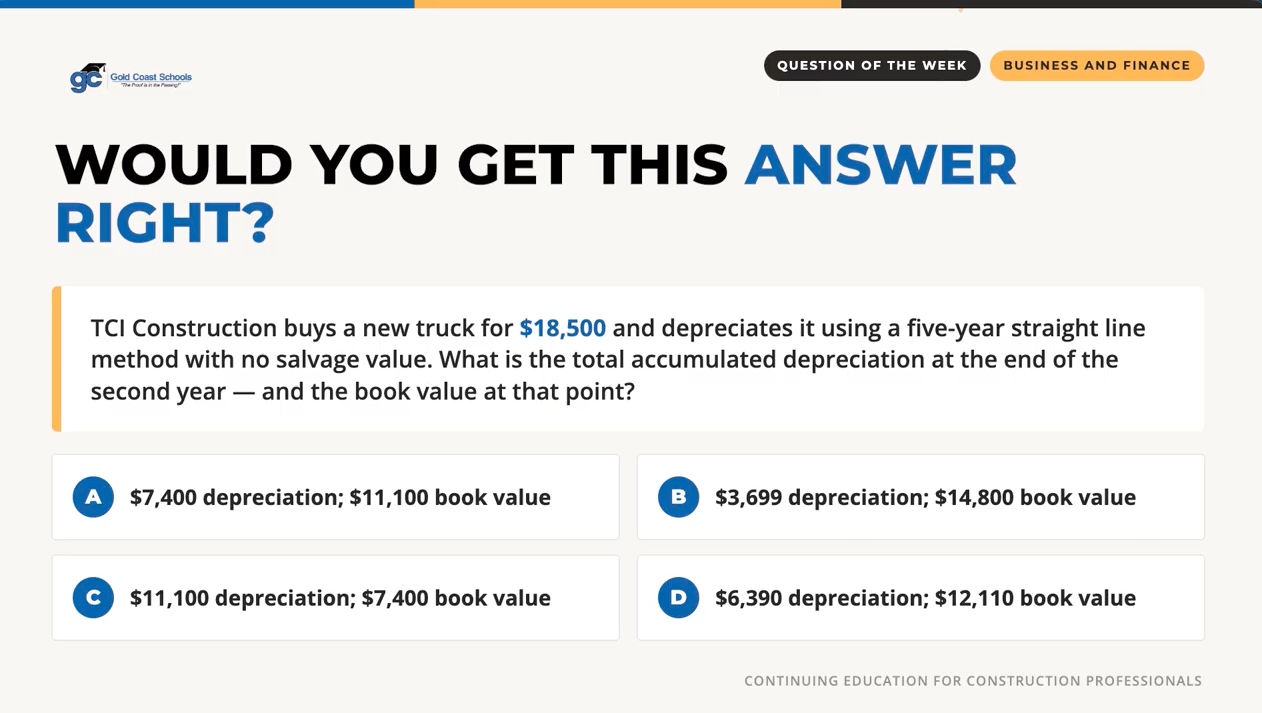
TCI Construction buys a new truck for $18,500 and depreciates it using a five-year straight line method with no salvage value. What is the total accumulated depreciation at the end of the second year, and the book value at that point?
- A. $7,400 depreciation; $11,100 book value
- B. $3,699 depreciation; $14,800 book value
- C. $11,100 depreciation; $7,400 book value
- D. $6,390 depreciation; $12,110 book value
What Is Straight-Line Depreciation?
Straight-line depreciation spreads the cost of an asset evenly across its useful life. It answers a simple question: how much value does this asset lose each year, assuming it loses the same amount every year?
Three terms matter for this calculation:
- Depreciation: how much value the asset loses in a given period
- Salvage value: what the asset is expected to be worth at the end of its useful life
- Book value: what the asset is worth on paper right now, after subtracting depreciation taken so far
When a question says “no salvage value,” that’s a signal the full cost of the asset gets depreciated down to $0 over its useful life. That detail changes the math, so it’s worth circling the first time you see it on an exam question.
Step 1: Find the Annual Depreciation
The straight-line formula is:
Cost of asset ÷ Useful life = Annual depreciation
For this question:
$18,500 ÷ 5 years = $3,700 per year
That $3,700 is the amount TCI Construction can depreciate the truck by every single year of its five-year useful life.
Step 2: Find the Accumulated Depreciation
The question asks for the total accumulated depreciation at the end of the second year, not the first. That means the $3,700 annual figure needs to be counted twice:
Year 1: $3,700
Year 2: $3,700
Total: $7,400
That $7,400 is the accumulated depreciation, the running total of value the truck has lost across both years.
Step 3: Find the Book Value
Book value is what’s left of the asset’s original cost after subtracting accumulated depreciation:
Original cost − Accumulated depreciation = Book value
$18,500 − $7,400 = $11,100
That gives a book value of $11,100 at the end of year two.
The Full Depreciation Schedule
Seeing all five years side by side makes the pattern easier to spot: the truck loses the same $3,700 in value every year until it hits $0, right on schedule with its five-year useful life.
| Year | Annual Depreciation | Accumulated Depreciation | Book Value |
|---|---|---|---|
| 0 (purchase) | — | — | $18,500 |
| 1 | $3,700 | $3,700 | $14,800 |
| 2 | $3,700 | $7,400 | $11,100 |
| 3 | $3,700 | $11,100 | $7,400 |
| 4 | $3,700 | $14,800 | $3,700 |
| 5 | $3,700 | $18,500 | $0 |
The Correct Answer
The correct answer is A: $7,400 depreciation; $11,100 book value.
Why the other options don’t hold up:
- B ($3,699 depreciation; $14,800 book value) reflects only one year of depreciation, not two, and rounds the annual figure incorrectly.
- C ($11,100 depreciation; $7,400 book value) swaps the depreciation and book value figures. This is the most common mistake on this type of question, so double-check which number the question is actually asking for before selecting an answer.
- D ($6,390 depreciation; $12,110 book value) doesn’t match a two-year straight-line calculation on this asset at all, and likely comes from a miscalculated annual depreciation figure.
Why This Type of Question Trips People Up
It’s rarely the math itself that causes a wrong answer here. It’s usually one of these:
- Reading “no salvage value” but still subtracting a leftover value that isn’t in the problem
- Calculating one year of depreciation instead of the number of years the question actually asks for
- Mixing up which number is the accumulated depreciation and which one is the book value
Slowing down enough to identify exactly what the question is asking for, one year or multiple, depreciation or book value, is often the difference between a right and wrong answer under exam time pressure.
Get Ready for the Florida Business and Finance Exam
Depreciation, book value, and asset accounting show up regularly on the Florida Business and Finance exam, and they’re just one piece of the material candidates need to know cold before test day.
Gold Coast Schools offers Florida contractor exam preparation, including Business and Finance exam prep, practice questions, and instruction from working professionals like Chris Clausing.

Frequently Asked Questions
What is the formula for straight-line depreciation?
Straight-line depreciation is calculated by dividing an asset’s cost by its useful life: Cost ÷ Useful Life = Annual Depreciation. When there’s no salvage value, the full cost of the asset is depreciated over its useful life.
What is the difference between depreciation and book value?
Depreciation is the amount of value an asset loses over a given period. Book value is what the asset is worth on paper after subtracting all depreciation taken so far from its original cost.
How do you calculate accumulated depreciation over multiple years?
Multiply the annual depreciation amount by the number of years that have passed. For an asset depreciating at $3,700 per year, the accumulated depreciation after two years is $7,400.

Interested in becoming a Florida real estate agent?
Connect with an enrollment advisor today.
By clicking “Submit”, you authorize Gold Coast Schools (“us”) to deliver, or cause to be delivered, to you at the phone number you provided above with telemarketing, promotional, informational, and transactional calls and/or text messages using an automatic telephone dialing system or prerecorded/artificial voice. Message and data rates may apply. Text message and call frequency varies. You may opt-out of receiving texts at any time by replying “STOP”. You may opt out of receiving calls/texts by contacting us at info@goldcoastschools.com and letting us know you want to opt-out. Reply “HELP” to a text for assistance. Calls and texts may be recorded for quality and training purposes. Your consent is not required to purchase any goods or services from us.
By clicking “Submit”, you also agree to receive commercial, promotional, and transactional emails from us at the email address you provided above You can opt out of receiving future emails at any time using the unsubscribe link in our electronic messages or by contacting us at info@goldcoastschools.com and letting us know you want to opt-out. See our Terms and Conditions and Privacy Policy for more information.
By clicking “Submit”, you authorize Gold Coast Schools (“us”) to deliver, or cause to be delivered, to you at the phone number you provided above with telemarketing, promotional, informational, and transactional calls and/0r text messages using an automatic telephone dialing system or prerecorded/artificial voice. Message and data rates may apply. Text message and call frequency varies. You may opt-out of receiving texts at any time by replying “STOP”. You may opt out of receiving calls/texts by contacting us at info@goldcoastschools.com and letting us know you want to opt-out. Reply “HELP” to a text for assistance. Calls and texts may be recorded for quality and training purposes. Your consent is not required to purchase any goods or services from us.
By clicking “Submit”, you also agree to receive commercial, promotional, and transactional emails from us at the email address you provided above You can opt out of receiving future emails at any time using the unsubscribe link in our electronic messages or by contacting us at info@goldcoastschools.com and letting us know you want to opt-out. See our Terms and Conditions and Privacy Policy for more information.
Need Help?
We're here for you!
Our expert enrollment advisors are available with any questions you might have.
800.732.9140
Hours:
Mon-Thur 8am - 6pm (EST)
Fri 8am - 5pm (EST)
Sat 8am - 12:30pm (EST)