
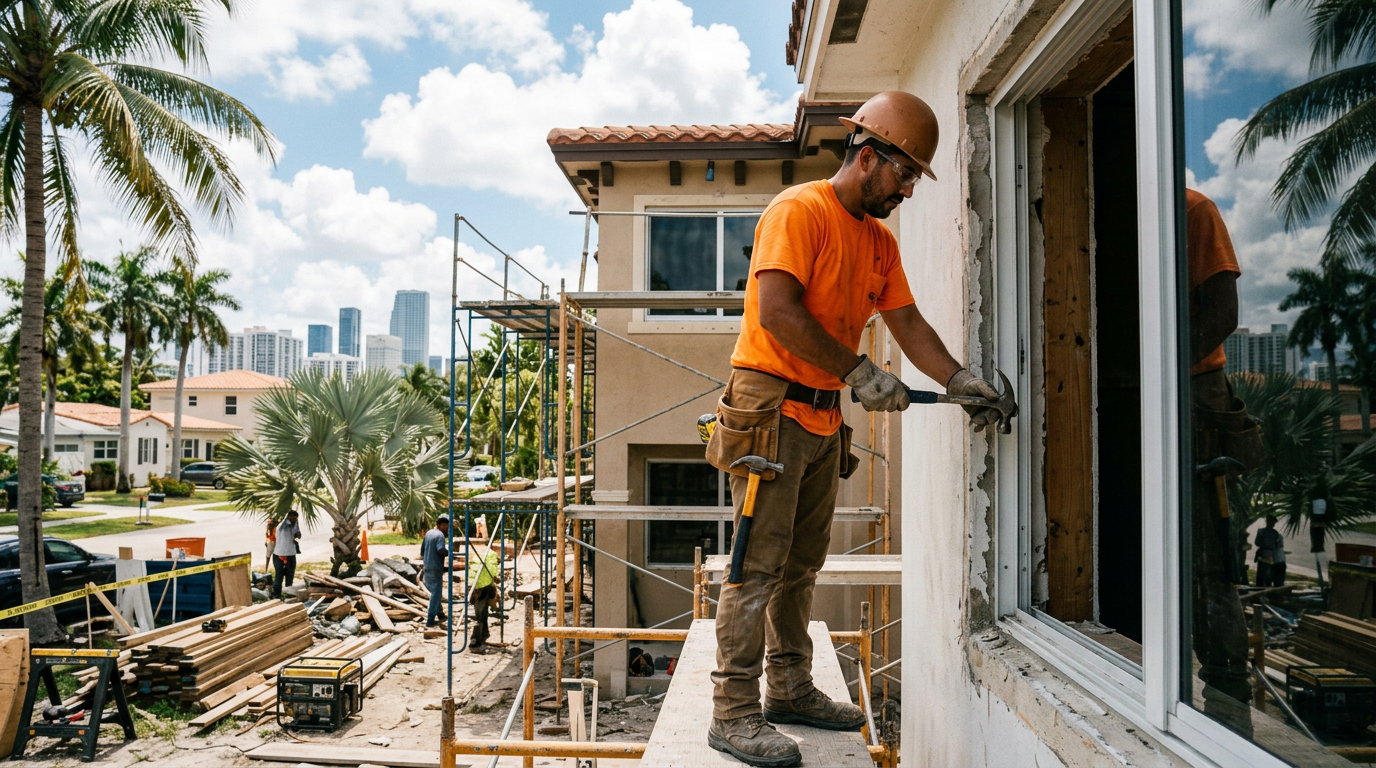
Miami-Dade is one of the busiest construction markets in Florida. New residential towers, hurricane-hardening retrofits, and a steady stream of remodels mean licensed contractors are in demand across every trade.
If you’re ready to turn your field experience into a license, here’s exactly what the process looks like.
Two Paths to Get Licensed
Miami-Dade contractors work under a two-tier system: a state license through the Florida Department of Business and Professional Regulation (DBPR), and in some cases a county-level Certificate of Competency through Miami-Dade’s Construction Trades Qualifying Board.
Which path you take depends on where you want to work and which category fits your trade.
State Certified Contractor (DBPR)
This is the license to get if you want the freedom to work anywhere in Florida, not just Miami-Dade. It’s issued by the state and covers General, Building, and Residential Contractor categories, along with most specialty trades.
Miami-Dade County Certificate of Competency (COC)
This is a Registered license limited to work within Miami-Dade County. It’s issued locally by the county’s Contractor Licensing Section and still applies to General, Building, and Residential Contractor categories.
One important note: a series of state laws (HB 735 in 2021, HB 1383 in 2023, and SB 1142) phased out many local specialty licenses that duplicated state categories, with most of those changes taking effect between July 2024 and July 2025.
If you’re pursuing a specialty trade like tile, flooring, or drywall, check current requirements directly on Miami-Dade’s Contractor License Category Preemption page or with DBPR before assuming a local license is still needed, since this is one of the areas where the rules have shifted recently.
Steps to Get a Miami-Dade County Certificate of Competency (COC)
The county route is worth a closer look, since it has its own category structure, documentation requirements, and board process separate from the state.
- Pick your category. Miami-Dade’s Construction Trades Qualifying Board issues COCs under General, Building, and Residential Contractor categories, each with a different scope:
- General Contractor covers work of unlimited size and height across any structure type.
- Building Contractor covers commercial and residential structures with some height and construction-type limits.
- Residential Contractor covers single-family homes, duplexes, and townhomes. Your category determines both your experience requirement (one to four years) and the scope of permits you’ll be able to pull once licensed.
- Document your field experience. You’ll need letters from employers stating your dates of employment and a description of the work you performed, backed up by W-2 tax documents covering that same period. The board is looking for a clear, verifiable work history, not just a resume line.
- Apply for your personal certificate and sit for the exam. Personal applications cover both exam and non-exam categories, depending on your trade. Where an exam is required, it’s open-book, drawn from a list of approved reference materials provided at the time you request your application, and requires a 70% or better to pass.
- Move from personal to business license. A personal certificate of eligibility or competence is a prerequisite, not the finish line. To actually contract for work, you’ll need a separate business application filed as a sole proprietorship, partnership, or corporation.
- Meet the Qualifying Agent requirement if you’re licensing a business. If you’re the Qualifying Agent for a company, county code requires you to hold a real financial or ownership interest in that business, such as serving as an officer, partner, or principal stockholder, not just lending your license to someone else’s operation.
- Carry the required insurance. Minimum liability coverage is $300,000 for bodily injury and $50,000 for property damage, and your certificate of insurance needs to list Miami-Dade County as the certificate holder. Workers’ compensation coverage or a valid exemption is required as well.
- Get your Business Tax Receipt. Beyond the COC itself, you’ll typically need a Contractor’s Business Tax Receipt from the Miami-Dade County Tax Collector before you’re fully set up to operate.
Renewal for county certificates requires 16 hours of continuing education per cycle, and certificate holders must stay registered with DBPR if their category requires it under Florida Statute Chapter 489. The board also waives the initial application fee for military veterans who apply within 24 months of discharge.
If you want the full breakdown of the state certification exam structure, fees, and renewal cycle, we cover it step by step in How to Get a Florida General Contractor License.
A Few Things Worth Knowing Before You Start
- Processing takes time. DBPR applications typically take three to six weeks. Miami-Dade County COC applications run four to six weeks depending on volume and how complete your paperwork is.
- Your reference books matter more than memorization. Both exams are open-book, so knowing how to navigate your reference materials quickly, not just knowing the answers cold, is often the difference between passing and failing.
- A state license doesn’t require the county exam. If you go the DBPR route and register locally, you skip Miami-Dade’s exam entirely. That’s a meaningful factor if you’re weighing which path fits your timeline.
Get Exam-Ready with Gold Coast
Whether you’re heading for a state certification or a Miami-Dade County Certificate of Competency, the exam is the part most candidates worry about most. Gold Coast School of Construction has been preparing Florida contractors for licensing exams for decades, with courses built around the actual exam content and reference materials you’ll use on test day.
Ready to get started? Explore our Florida contractor licensing exam prep courses and find the path that matches the license you’re after.

Frequently Asked Questions
Do I need both a state license and a Miami-Dade County certificate?
Not necessarily. If you get a Florida DBPR Certified Contractor license, you register with Miami-Dade County RER but skip the county’s exam and application process entirely. The county’s Certificate of Competency is really an alternative path for contractors who only plan to work within Miami-Dade and don’t need statewide reach.
Which license lets me work outside Miami-Dade?
Only the state DBPR Certified Contractor license. A Miami-Dade County Certificate of Competency is a Registered license, which means it’s valid only within the county that issued it.
How long does the whole process take?
Plan for roughly two to three months from application to licensed status. DBPR applications typically process in three to six weeks, and Miami-Dade County COC applications run four to six weeks depending on volume. That’s on top of the time it takes you to prepare for and pass your exam.
Are the exams hard to pass?
Both the state and county exams are open-book, so you’re allowed to bring approved reference materials with you. The challenge isn’t memorization, it’s knowing your reference books well enough to find the right answer quickly under time pressure. That’s exactly what contractor exam prep courses like Gold Coast’s are built to teach.
What if I only work in a specialty trade like tile, drywall, or painting?
Check current requirements carefully. State laws passed in 2021 and 2023 phased out many local specialty licenses that duplicated categories already regulated by the state, with most changes taking effect between July 2024 and July 2025. Depending on your trade, you may no longer need a Miami-Dade County certificate at all, or you may need a different state category than you’d expect. Verify directly with Miami-Dade County or DBPR before you apply.
What insurance do I need before I can get licensed?
Both paths require general liability coverage and either workers’ compensation insurance or a valid exemption. For a Miami-Dade County certificate, minimum liability coverage is $300,000 for bodily injury and $50,000 for property damage, with the county listed as the certificate holder. State requirements vary by category, so confirm your specific minimums with DBPR.
Can I apply if I don’t have four years of experience?
For the state Certified Contractor license, DBPR requires four years of field experience with at least one year in a supervisory role. Miami-Dade County’s Certificate of Competency has more flexibility, with experience requirements ranging from one to four years depending on the category you’re applying for.
Do veterans get any breaks on fees or requirements?
Yes. Miami-Dade’s Construction Trades Qualifying Board waives the initial application fee for military veterans who apply within 24 months of discharge.

Interested in becoming a Florida real estate agent?
Connect with an enrollment advisor today.
By clicking “Submit”, you authorize Gold Coast Schools (“us”) to deliver, or cause to be delivered, to you at the phone number you provided above with telemarketing, promotional, informational, and transactional calls and/or text messages using an automatic telephone dialing system or prerecorded/artificial voice. Message and data rates may apply. Text message and call frequency varies. You may opt-out of receiving texts at any time by replying “STOP”. You may opt out of receiving calls/texts by contacting us at info@goldcoastschools.com and letting us know you want to opt-out. Reply “HELP” to a text for assistance. Calls and texts may be recorded for quality and training purposes. Your consent is not required to purchase any goods or services from us.
By clicking “Submit”, you also agree to receive commercial, promotional, and transactional emails from us at the email address you provided above You can opt out of receiving future emails at any time using the unsubscribe link in our electronic messages or by contacting us at info@goldcoastschools.com and letting us know you want to opt-out. See our Terms and Conditions and Privacy Policy for more information.
By clicking “Submit”, you authorize Gold Coast Schools (“us”) to deliver, or cause to be delivered, to you at the phone number you provided above with telemarketing, promotional, informational, and transactional calls and/0r text messages using an automatic telephone dialing system or prerecorded/artificial voice. Message and data rates may apply. Text message and call frequency varies. You may opt-out of receiving texts at any time by replying “STOP”. You may opt out of receiving calls/texts by contacting us at info@goldcoastschools.com and letting us know you want to opt-out. Reply “HELP” to a text for assistance. Calls and texts may be recorded for quality and training purposes. Your consent is not required to purchase any goods or services from us.
By clicking “Submit”, you also agree to receive commercial, promotional, and transactional emails from us at the email address you provided above You can opt out of receiving future emails at any time using the unsubscribe link in our electronic messages or by contacting us at info@goldcoastschools.com and letting us know you want to opt-out. See our Terms and Conditions and Privacy Policy for more information.
Need Help?
We're here for you!
Our expert enrollment advisors are available with any questions you might have.
800.732.9140
Hours:
Mon-Thur 8am - 6pm (EST)
Fri 8am - 5pm (EST)
Sat 8am - 12:30pm (EST)